
Friday 17 April 2026 marks the first World Public Transport Day, recognising the role public transport plays in keeping people and communities moving.
It is a chance to step back and consider the role rail plays in everyday life across the East of England. Greater Anglia and neighbouring operator c2c connect people to work, education, family and opportunity. They support the day-to-day rhythm of towns and cities and provide a practical alternative to travelling by car.
Public transport only works when it works as a system. It underpins how a region functions day to day. When it is reliable, easy to use and properly connected, it supports jobs, growth and access to opportunity in a way that few other things can.
Across East Anglia, that role is significant. Greater Anglia serves six counties and operates 135 stations, while c2c operates 26 stations across 2 counties. Together, the two operators carry almost 120 million passengers each year, with Greater Anglia carrying over 80 million and c2c over 38 million.
That growth is reflected in how people are choosing to use the railway. On routes such as Norwich to Sheringham, passenger journeys have now increased more than fourfold (since 1994). Journeys between Norwich and Cambridge have more than tripled (since 2002), while Ipswich to Lowestoft has seen passenger numbers more than double (since 2010). These increases have followed improvements in service frequency, reliability and quality.
Indeed, over the past twelve months, GA and c2c have also been among the most punctual operators in the country.
Rail works best when it connects with everything around it
Rail is at its most effective when it works as part of a wider journey.
For most passengers, the train is only one part of how they get from door to door. What also matters is how easily that journey continues, whether that is a bus, a bike or the final stretch on foot.
Across the Greater Anglia network, the focus on the full journey is becoming more visible. More than 10,000 cycle spaces support those combining rail and cycling, while PlusBus provides a simple way to include onward bus travel without needing to manage separate tickets.
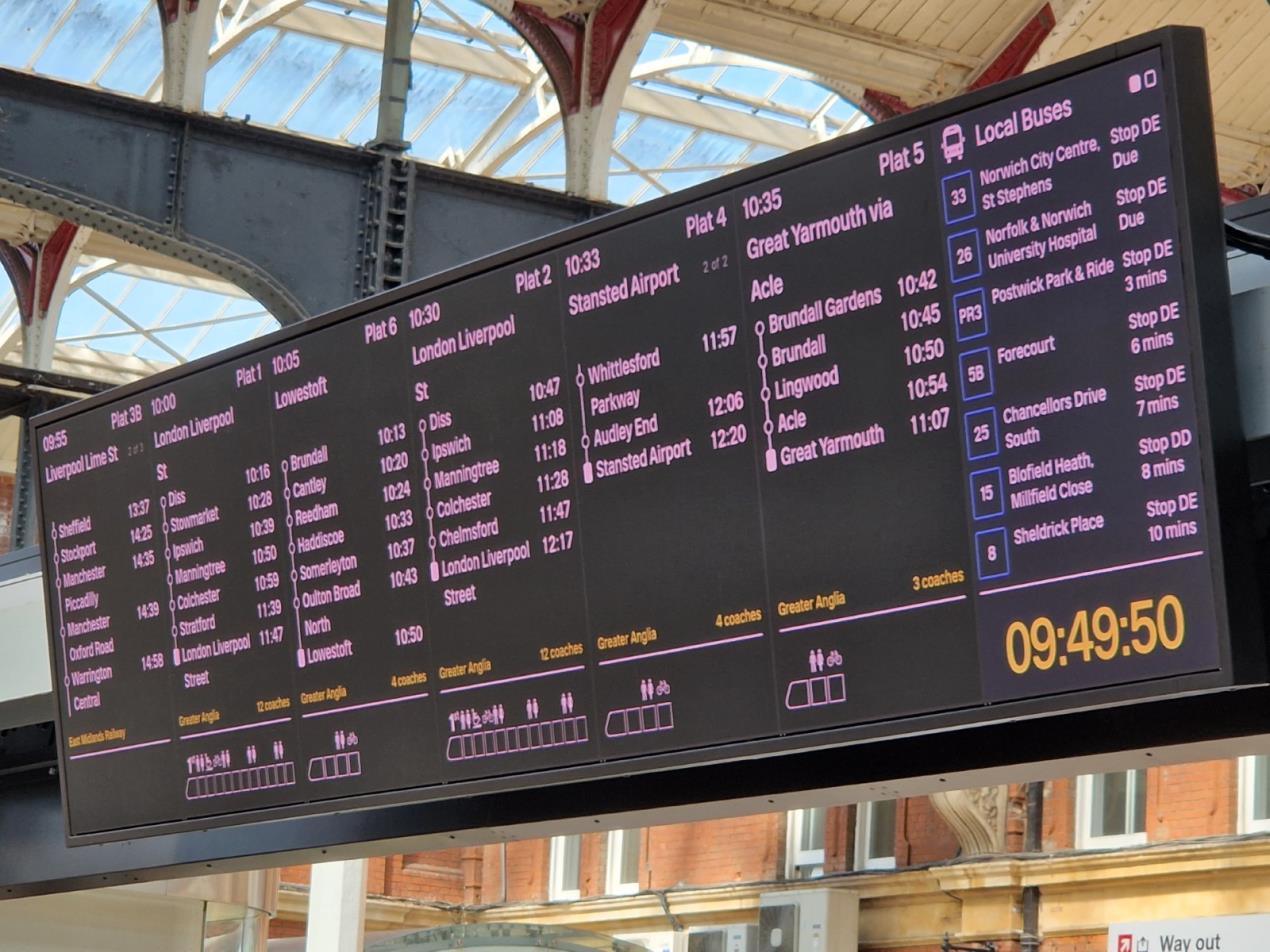
There have also been practical improvements in how information is provided at many stations. Upgraded customer information screens at Ipswich, Norwich, Cambridge and Great Yarmouth bring together clearer, real-time updates, including bus service information, helping passengers understand both their train times and onward connection options.
Norwich information board 2 (credit Greater Anglia)
Above: Customer Information screen at Norwich (Credit: Greater Anglia)
Alongside this, new digital tools are making it easier to plan ahead. A recently introduced integrated transport section of the Greater Anglia website brings together first and last mile options in one place, so passengers can see how their journey fits together before they travel.
There has also been a renewed focus on encouraging more sustainable onward travel, including partnerships such as discounted Beryl bike hire in Norwich to support short onward journeys.
Taken together, these changes make journeys easier to navigate and bring public transport closer to operating as a single, connected system.
Greater Anglia is also working more closely with neighbouring operator c2c to support a more consistent experience for passengers travelling across the wider region.
c2c has also taken steps to simplify journeys across its network, including becoming the only National Rail operator to offer a fully contactless network, with more than three million contactless journeys recorded in its first year. Meanwhile, Greater Anglia has recently extended its contactless pay-as-you-go offering to an additional 20 stations on its network, including the route between London Liverpool Street and Stansted Airport.
In addition, c2c has partnered with Southend and London City airports to encourage rail travel and reduce reliance on private vehicles.
We also work closely with Network Rail Anglia, including at London Liverpool Street, the busiest station in Britain, where ongoing improvements such as the renewal of the station roof are helping to enhance the environment and overall customer experience.
For passengers, travelling across East Anglia should feel straightforward. One connected journey from start to finish.
The railway is part of community life
Railways do not just connect places. They are part of how communities function day to day.
One of the clearest examples of that is station adoption. Across the Greater Anglia network, more than 325 volunteers help care for over 125 stations, from maintaining gardens to shaping spaces that reflect their local area. It gives communities a direct role in how their station is used and developed.
That wider role is also reflected in Greater Anglia’s Community Rail Partnerships. Across lines in Norfolk, Suffolk, Essex, Cambridgeshire and Hertfordshire, these partnerships help make local lines more relevant to the people they serve, encouraging new groups to use the railway and ensuring stations are right at the heart of their local communities.
The same principle sits behind Greater Anglia’s Customer and Community Improvement Fund. Since launching in 2024, the fund has invested over £700,000 into 62 projects across the network, supporting ideas that benefit both the community and the railway. Some are modest but effective, such as wildlife interpretation boards at Thetford and Lakenheath or a new garden at Bures. Others are more transformational, such as the refurbishment of a vandalised waiting room at Saxmundham into a community space shaped by local artists, schools and the East Suffolk Lines Community Rail Partnership.
Saxmundham 2
Above: Refurbished Saxmundham station waiting room (Credit: Greater Anglia)
This focus on local priorities and issues, which was integral to GA’s transformational fleet replacement programme, is also reflected in how people are using the network, with rural journeys increasing by 28% following the introduction of new trains.
c2c has also worked with local partners to bring community spaces into stations, including the ‘Gold Geese Lounge’ at Westcliff station, created in partnership with a local children’s cancer charity and artists.
gold geese lounge
Above: Gold Geese Lounge (Credit: Greater Anglia)
A more sustainable way to travel
In the past year alone, Greater Anglia has reduced its total carbon emissions by 11%, preventing more than 13,000 tonnes of CO₂ from entering the atmosphere.
A more modern fleet is a key part of that, with newer trains designed to use less energy and operate more efficiently across the network.
There has also been clear progress in reducing waste and improving resource use. During 2025/26, more than 69% of waste was recycled or reused, with 100% of applicable waste diverted away from landfill.
Alongside this, there has been a continued focus on biodiversity across the network, including an additional 400 square metres of station garden space, the installation of more than 50 bird boxes, and the creation of 18 new gardens, in the last 12 months alone.
c2c has also supported biodiversity projects across its network, including ‘Project Kestrel’, which has introduced nesting boxes and live-streaming to support local wildlife and community engagement.
Furthermore, c2c sources 100% renewable electricity for its non-traction energy use and continues to invest in energy efficiency across its operations.
For passengers, much of this is not always visible. But it is fundamental. A transport system that is efficient, reliable and lower carbon is essential if it is to support growth in a way that is sustainable over the long term.
Behind every journey
It is easy to focus on the journey itself. Less visible is the work that sits behind it.
Running a railway is a continuous operation, with teams working around the clock to plan, manage and deliver services. At the centre of that is the control function, monitoring the network in real time and making decisions to keep services moving, or recover them quickly when things go wrong.
Much of that work happens before the first passenger boards. Overnight, trains are prepared for service, moved between depots and stations, and checked to ensure they are ready to run safely the next day.
This activity happens at scale across the network. Over the past year, for example, c2c services alone have covered more than four million miles and made around 1.6 million stops.
This is a safety-critical environment, where coordination and judgement matter at every stage. For passengers, much of it goes unseen. But it underpins every journey that takes place.
A reliable railway depends not just on infrastructure and trains, but on the people who plan, operate and support it every day.
Looking ahead
Public transport only works when it works as a complete journey.
For passengers, that means something simple: services that are easy to understand, well connected and reliable day to day.
That is where the focus now sits: improving how the railway works and ensuring it connects effectively with the wider transport network across the region.
It also means working more closely across operators, including Greater Anglia and c2c, with colleagues at Network Rail Anglia, to deliver a more consistent experience for passengers travelling across East Anglia.
c2c is also planning for future growth along the Essex Thameside corridor, supporting increased passenger demand and strengthening freight connections into key ports across the region, while GA is collaborating with stakeholders on the case for upgrades at Ely and Haughley Junction, to enable more passenger and freight trains to operate on the region’s rail network.
As Andrew Summers, Chief Executive at Transport East, notes, rail is far more than just infrastructure. It is a vital enabler of opportunity, connecting people to jobs, education and each other, while supporting communities and driving economic growth.
It works best when it is fully integrated with other modes, particularly local bus services, to provide seamless, end-to-end journeys. Across the East, there remains a clear focus on delivering a joined-up, reliable and accessible public transport network that works for everyone.
The focus now, across GA, c2c and Network Rail Anglia, is on making that system simpler, more connected and more reliable for the people who depend on it every day.