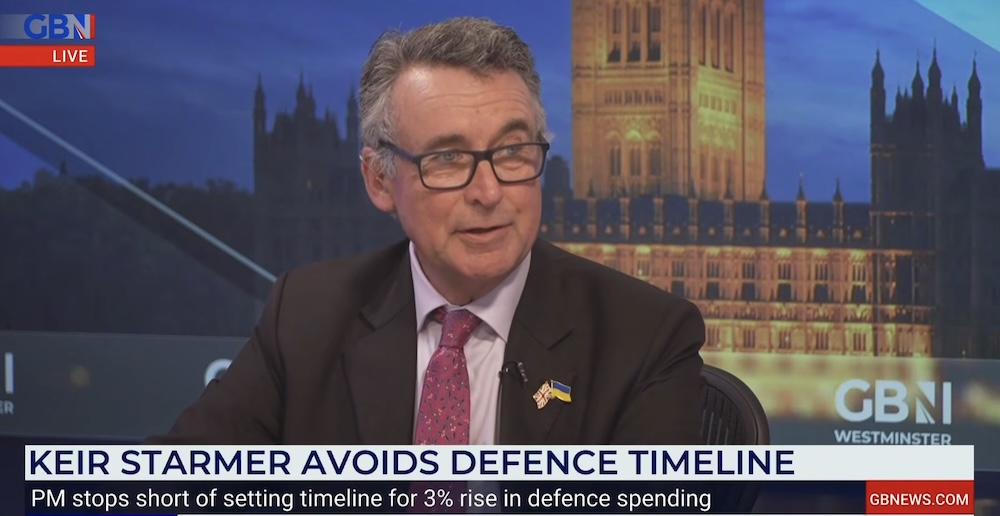
SIR Bernard Jenkin has said the Treasury is not approving an increase in defence spending to put the UK on a war footing because it expects to spend more money on welfare.
Speaking on GB News Sir Bernard Jenkin said: “I was not asking, ‘Why haven’t you transformed the armed forces in 18 months or addressed 30 years of decline in the Armed Forces in 18 months?’ I was asking, ‘Why haven’t you just even produced a plan in 18 months?’
“Here we are. We are at war. You may not want to be at war, but we are at war, and people saying, ‘Oh, we shouldn’t get too involved’, but we’re at war on two fronts.
“You ask the Russian foreign minister; he said Russia is at war with NATO and has been for years. And now Iran is actually attacking sovereign UK territory, and we didn’t have the kit there to defend our troops.
“It shows that we’re not delivering the defence that we need, and yet what the government is doing is not making any decisions about what should be bought or ordered, they’re still finalising a plan.
“And to understand why this plan is locked up somewhere, probably on the Prime Minister’s desk, as well as in the Treasury, the Treasury has not committed to any defence spending plans after 2029.
“And yet they’re being asked to approve a 10-year plan! Well, they’re saying no.
“The Treasury expect that they’ll have to spend more money on welfare because that tends to be the pattern. The government is increasing the welfare spending much, much more substantially than its increasing defence spending.
“And in fact, the increase in defence spending is very slight in cash terms and probably declining in real terms, because defence costs inflation tends to run ahead of real inflation, and there’s now a £2.6 billion black hole in the department’s programmes.
“The Prime Minister left immediately, but that’s usual. He had a Cobra meeting. I did say, ‘Can you just go and explain to the Treasury at the Cobra meeting, we are at war, and they ought to be on a war footing’.
“A war footing means everything’s changing very quickly. You look at how quickly the war has changed its character in Ukraine. We need to adapt to this new environment where drones have taken over from artillery, for example.
“I mean, we’re not going to defend NATO with banks of troops, masses of troops – we don’t have masses of troops in NATO conventional aircraft. We’re going to do it with drones.
“I mean, the Ukrainians have stopped the Russians in their tracks with drones, drones of all kinds: big drones, little drones, ground attack drones, air defence drones, short range drones, long range drones, night drones, day drones, lots and lots of different drones. Drones that fire missiles, suicide drones, kamikaze drones, surveillance drones.
“The Ukrainians have 450 companies that make a million drones a year and on the front line, the drone operators themselves work out what’s working and they order the drones they want from the companies.
“This is a million miles away from the way the procurement system works in the UK, and we’ve got to be there.
“And we’re using in the Middle East, for example, we’re using these fantastically expensive F35 fighters to bring down drones that go 150 miles an hour and cost a few hundred thousand pounds.
“It costs £25 million an hour to keep one of those airplanes up and we should be moving much, much faster on the adaptation of our armed forces. And it’s not about whether you’ve got a plan, you’ve got to get on with it. Because the Russians and the Chinese and the Iranians are looking at the whole of Europe and thinking, ‘What planet are they on? They look so weak.’
“When I was in Ukraine, the Ukrainian Armed Forces say we’ve made an offer to the joint expeditionary force of NATO, which includes the British Army, to help you adapt your frontline forces on the NATO front line.
“I would say there was a lot of conservatism in the senior echelons of the armed forces and disappointingly, the MoD was created to get rid of inter-force rivalry. My goodness, there’s been some inter-defence rivalry.
“But that reflects a lack of leadership from the top. And I always thought if I was ever Secretary of State for Defence, I was shadow Secretary of State for a time, I would take away the chiefs of the armed forces, and we’d shut ourselves away for at least a week, until we had agreed what we were going to agree on.
“Because if you want to change things in the Ministry of Defence, then everybody at the top’s got to agree.”